My family’s paternal Irish immigrant ancestors were among the great throngs of refugees fleeing Ireland in the middle of the nineteenth century. The main event from this time is often inaccurately referred to as the Irish Potato Famine but it is more appropriately described in Irish as An Gorta Mór or The Great Hunger. Hunger and poverty were a constant problem for an overwhelming majority of the Irish population under British rule for years and years both before and after this short but particularly harrowing period. Not because there was an actual lack of food in the country, but because the most feasible means of sustenance available for the majority of families at the time was the potato. As a crop, it could be grown in small dense patches. As a food source, it could be safely stored for good stretches of time and is nutritiously complex enough to be able to subsist on as one’s main diet. This was, then, what seemed the perfect food source for the great numbers of Irish who were small tenant farming families and farm laborers. Yet the potato plant wasn’t a perfect crop and its product wasn’t quite enough to solve all their problems. There was a delicate balance needed to be maintained: families had to earn enough of a profit from what they cultivated on their holdings to pay their landlord’s exorbitant rents but they also had to grow enough food to provide for themselves each and every year.
This particular crisis resulting in the deaths of over a million people and making refugees of over a million and a half would transform America by effectively altering the ethnic make-up of its major cities. It would also provide an endless supply of cheap labor from desperate bodies unloading at its ports. Alternatively, it would devastate Ireland’s population and wound that nation’s soul for generations. What follows here is a short chronicle of the effort made to pull back the curtain on our family’s forgotten history and what led us to finally locate where in Ireland our people came from.
Background
Despite a small trove of keepsakes and family records that were saved by our McKeon family over generations, the effort to locate our ancestral origins in Ireland has been a slow and decades-long process. Many of our McKeon family records, some dating back one hundred and seventy years, eventually ended up with two people; my father, Robert McKeon, who was doing family research on and off since the early 1970s and his first cousin, Ann. Important remnants of their forebear’s lives were gathered up for safekeeping once a decision was made to sell the McKeon ancestral home in Stamford, Connecticut after the death of its last resident, their paternal aunt, Mary E. McKeon (1886-1974). A collection containing original documents, photographs, letters, old newspapers, a family Bible, and other assorted tokens from the family’s past would remain for decades with these two individuals and kept available when needed. Thankfully, the relevance of many of these items to our family’s history would eventually be recognized and appreciated. They would not be forgotten or, worse yet, carelessly discarded over time.

As my father’s eightieth birthday approached in May of 2011, and with his health in decline after nearly a lifetime of smoking, I recognized that a window of opportunity was available to produce a summary of his research for our extended family. This would include images of all the important documents and family photographs that were collected. The undertaking was something that I felt could be achieved, but I needed to act promptly. So, I packed up my father’s family records to bring home with me. The information found there I could likely use alongside other information that could be found on the internet with sites like Ancestry.com or any of the other family history sites that will connect you so easily to millions of online historical records.
The use of the internet and computers, in general, seemed to be confounding to my father whenever I had tried to instruct him or encourage him to take advantage of these resources for his genealogy research. As with many seniors, email seemed to be something that he could quickly pick up and use with a bit of ease but for some reason trying to understand how to navigate the internet was a major obstacle. Like other family researchers of his generation, he did his work the old-fashioned way. He drove, for instance, from Long Island to Connecticut or into Manhattan on many occasions to view physical records or those found on microfilm at the various archives, town halls, and libraries. He corresponded by mail with distant relatives or municipal offices where records he hoped to come across might be found and he also joined a local Irish genealogy group to learn more about Irish records that might be particularly helpful for his specific research. He even visited a family history center on one of many trips to Ireland where his possible McKeon connections might be from. Discovering new information about all of his ancestor’s lives was always interesting, but it was his McKeon lineage that interested him the most.
So, a very solid foundation had already been laid before me, and soon began what I thought might be a six-month project with one additional but important goal; trying to discover, at the very least, the county in Ireland where our McKeon family originated. The hope was to get to that point before we were to celebrate my father’s birthday. I came to understand how lofty that goal was after those six months flew quickly by and little did I know how difficult but rewarding this undertaking and the continuation of the research would be.
A foundation to build on
My second great-grandfather, Patrick McKeon (1817-1871), likely arrived in New York City from Ireland around 1844. This was just before the most desperate of Irish refugees fleeing hunger and poverty during one of the most terribly grim periods in Irish history began arriving there by the shipload. The year is based on Patrick’s first filing of his U.S. citizenship paperwork: a Declaration of Intention recorded on the 8th of April, 1844 at Marine Court in New York City. (i) Not much is known about the period between Patrick’s arrival and November of 1851 when Patrick married Ann Farrell at Saint Patrick’s Old Cathedral on Mott Street in lower Manhattan. Presumably, this would have been Ann’s parish according to tradition.
Ann Farrell’s early years in New York City are similarly unknown. A Bible, published in New York in 1846, is personalized with Ann’s maiden name embossed on the front cover and is one of several precious family gifts that have survived over the generations. The Bible also contains Ann’s name and address handwritten inside the front cover. There it reads Ann Farrell, 169 Madison Street. That address was a location on New York City’s Lower East Side. These details suggest that Ann may have been in New York as early as 1846 or 1847.
The celebrant for the couple’s 1851 marriage was the Rev. John Loughlin, the pastor of Saint Patrick’s & the Vicar-General of the Archdiocese of New York under Archbishop John J. Hughes. Seventeen months later, Loughlin would be appointed the first Bishop of the newly formed Diocese of Brooklyn, New York. The witnesses for the marriage were Patrick Short, the husband of Ann’s presumed sister, Catherine Farrell (this couple would also settle in Stamford), and Bridget Peyton whose relationship to the couple is still unknown. (ii)
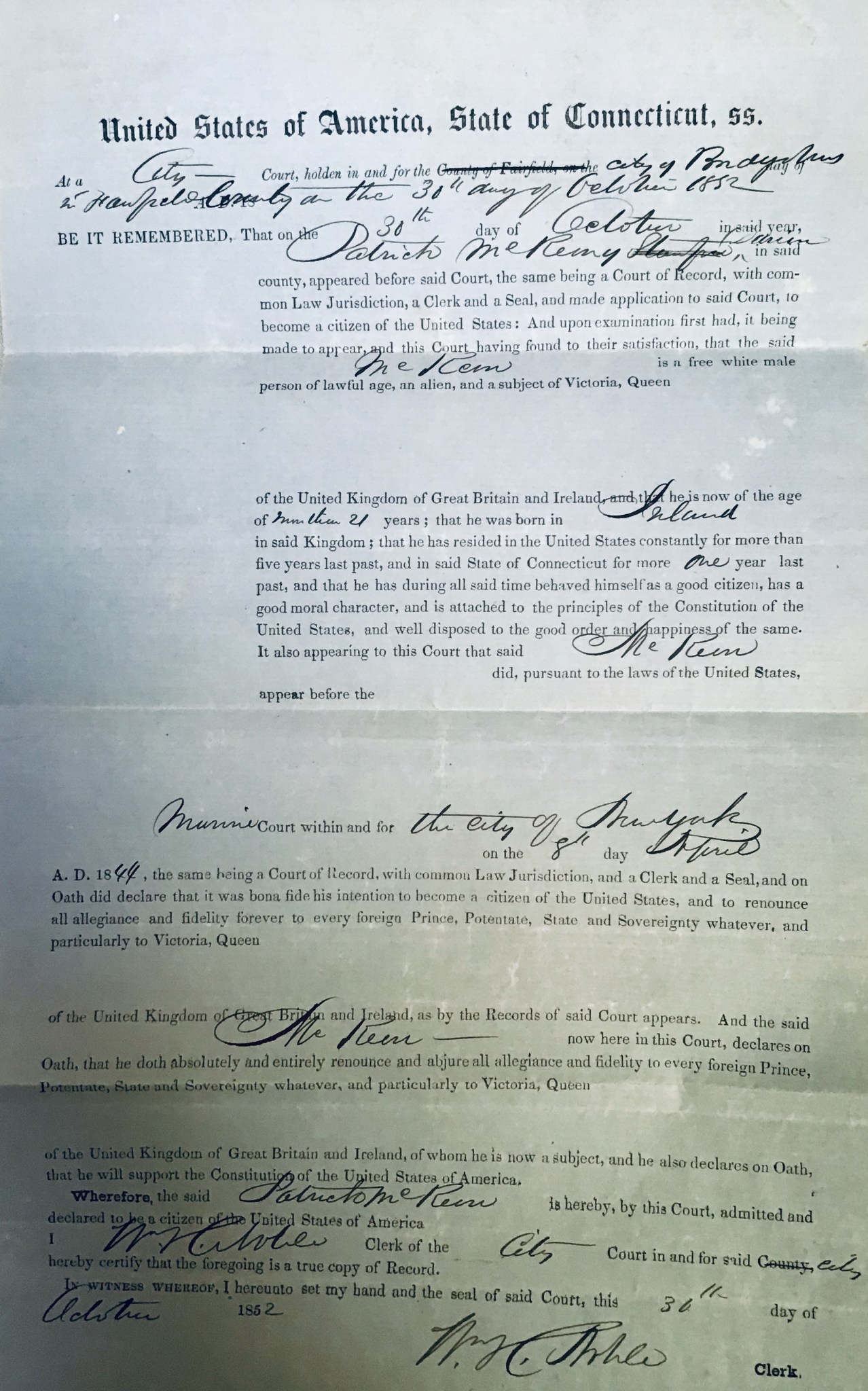
Neither Patrick nor Ann could be specifically identified in the 1850 U.S. Census records. However, shortly after their marriage in 1851, they were living about forty miles northeast of New York City in Darien, Connecticut. Darien, then, was a small town in Fairfield County whose boundaries were originally part of the neighboring town of Stamford, Connecticut prior to its formation in 1820. It is known that our McKeons were in Darien because Patrick and Ann’s first child, Mary Ann, was born there in September of 1852. Also, when Patrick finalized his naturalization on the 30th of October 1852, at City Court in Bridgeport, Connecticut, the declaration lists on that document that his town of residence was Darien. It states there that he was a resident of Connecticut for more than “one year last past”.
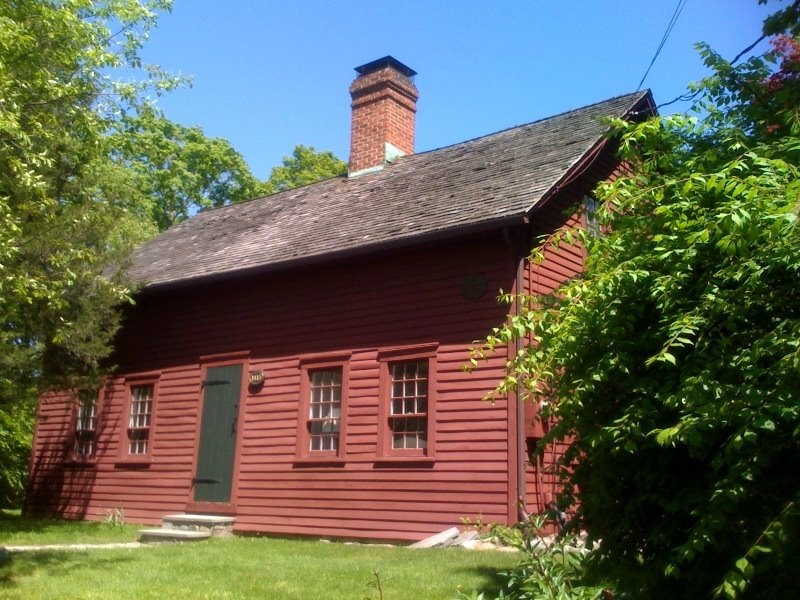
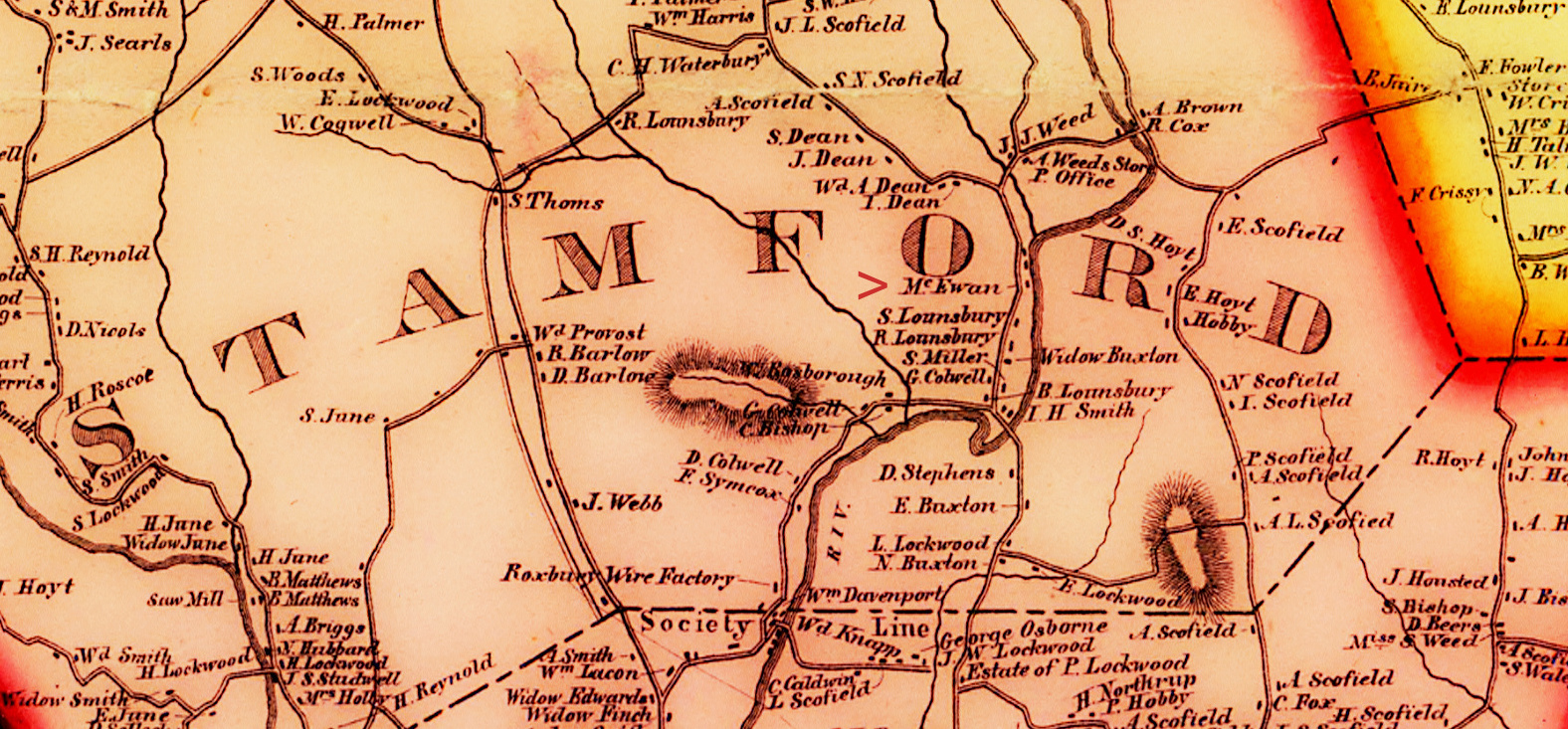
In April of 1853, Patrick made a bold move in purchasing land that included about sixty acres of farmland, a small bit of woodland and a one-hundred-year-old colonial wood frame house in an area of North Stamford, Connecticut that was known as Turn of River (see photo above and map further below). The location borders a section of Stamford’s Mill River where it meanders on a course southward toward the City of Stamford before emptying into Long Island Sound. As a landowner and farmer, the right to vote as a full citizen would be of great importance to any American but important rights weren’t always readily available to all. The State of Connecticut, in 1855, had enacted a literacy test along with a one-year residency requirement in order to vote. This was specifically aimed at restricting the Irish-Catholic vote and those of immigrant newcomers like Patrick. The large numbers of Irish flocking to Connecticut’s towns and cities were viewed as a voting threat by some in the establishment and by making quick inroads into Connecticut society in greater and greater numbers, their challenge to the old guard may have seemed real enough.
The sale of the house and farmland to Patrick was financed with loans and one of the individuals involved in the sale to Patrick was Edward C. Badeau, a New York City fruit merchant. Edward’s wife was from an old Connecticut family, the Deans, from North Stamford. Perhaps Patrick worked for or knew Badeau at some point during his time in New York City and was offered assistance coordinating the purchase based on some goodwill that was earned. Whatever the case may have been, it appears that Patrick had very firm plans in mind for his family’s future when he made the move to Connecticut.
Piecing clues together
Of interest in one of the early McKeon land purchase records from Stamford was the discovery of a possible relative of Patrick, a John McKeon, whose name appears on a record as a witness. Unfortunately, Patrick’s relationship with this individual is not provided. There was only one adult named John McKeon found living in Stamford around this time and this same individual, whose particulars were traced through various town records, had died in August of 1890 in Stamford. This John McKeon’s name was also found included on a list of deaths located among some of our old McKeon family papers. On the back of the undertaker’s bill saved from Ann Farrell McKeon’s funeral in 1893 is a handwritten list of ten deaths. The earliest name on the list was Patrick McKeon’s whose death took place in 1871, followed by some other known McKeon and Farrell relatives from Stamford. Two of the individuals listed, including a McKeon female who died in Bridgeport, Connecticut, are still yet unknown as to their exact connection with the family. That John McKeon and these two other individuals appear on such a list strongly suggests that they were also closely related to our McKeon family. But how?
John McKeon and his wife Ellen were first located in the 1860 U.S. Census record living in Stamford town with two young sons. John is listed there as a farm laborer. There, it states that both John and Ellen were born in Ireland. John was 35 years of age (establishing an estimated birth year of 1825). Further research revealed that the couple had married in 1855 in Stamford and that all of their children were born there.
A discovery in 2012 that our Stamford McKeon family’s burial information had been published online on a genealogy website led to locating the individual responsible for recording the information; Toni McKeen. Toni is the wife of one of the descendants of Irish immigrants John and Ellen McKeon of Stamford and she has been doing family research and lectures on genealogy for many, many years. When contacted, the possible family connections were discussed. Both of us had come to a similar conclusion: Patrick McKeon and John McKeon were likely brothers. It would be important then, for me, to try and locate as much information for John McKeon and his descendants in the hope that it would eventually lead to additional clues. John’s wife, named in the marriage record in Stamford, was Ellen Maher and they had five children together. Some descendants of John and Ellen (Maher) McKeon continue to live in Stamford and its environs to this day.
Patrick and Ann McKeon had a total of three children during the course of their marriage. Daughter Mary Ann was born in 1852 in Darien, John Joseph (my great-grandfather) was born in 1854 in Stamford and James was born in 1859, also in Stamford. The children were all baptized at St. John the Evangelist Roman Catholic Church in Stamford’s downtown. The first Catholic church in Stamford, it was at that time a small wood-frame building, erected circa 1850 by newly arrived Irish immigrants to Stamford and its vicinity. A few decades later, a larger and more elegant gothic style church would be built to serve the needs of the ever-growing Catholic population there, including our McKeon family. One of the very few personal glimpses into Patrick McKeon’s life that was discovered was information that he served as president of the St. John’s Roman Catholic Benevolent Association’s annual ball in 1865. (iii) This fact, found reported in the local newspaper announcing the organization’s event, demonstrates that Patrick and his family were fully ensconced in the St. John’s parish community.
The Search…
Where exactly in Ireland were Patrick and Ann from? It is a question that many in our family have asked over the years. When my father first began serious research into that mystery in the early 1970s, my father’s aunt, Mary E. McKeon (1886-1974), who grew up and lived most of her life in the McKeon ancestral home, had mentioned County Longford at some point but there were no specifics or details about how certain she was or exactly how she knew of this. My father’s cousin, Ann, who grew up in the house next door to the McKeon farmhouse with her parents, James and Anna McKeon, and sister, Kay, had heard that the McKeons and Farrells were from Counties Sligo and Leitrim. Doing research for our McKeon family in Stamford and the McKeon surname in Ireland and finding all the many places where 19th-century records of McKeon families could be found led to much frustration for my father because there seemed a very distinct possibility that he might never be able to find where exactly our McKeon family had lived before leaving Ireland.
Patrick’s marriage & citizenship certificates, land records, and the 1860 U.S. Census records all show the family surname spelled as M-c-K-e-o-n, while some other early records found in Connecticut such as the 1870 U.S. Census, a church baptism record and a local map had some variations of the surname, showing as McKone, McCune, McEwan, etc. Spelling variations from this time are not uncommon for Irish family records, especially when some Irish surnames were not yet standardized and many Irish immigrants couldn’t even read or write as appeared might have been the case with Patrick and Ann. They left marks of ‘X’ in place of a signature for the few records found requiring it. U.S. Federal Census records from 1870 and 1880 which include a column to indicate whether an individual cannot read or write were left incomplete by the enumerator responsible for canvassing the location where our McKeon family lived. Therefore, we do not know for certain what the complete picture was in terms of their literacy. Were the different surname spellings clues as to how the family may have pronounced the name and therefore hinted at a specific region of Ireland, say Ulster, or the Midlands, or Connaught where most of the McKeon families in Ireland from this time were found in the largest numbers? As the inconsistencies in spelling appeared few, it seemed that there was little to suggest any additional clues would be picked up through researching that angle further.
The Farrell or O’Farrell surname was certainly most prevalent in the 19th century in County Longford where that clan held control for some of that area for many centuries earlier. Perhaps then it was our Ann Farrell who hailed from Longford and maybe Patrick was from one of the other counties mentioned? Lack of specific birth information in records found for Patrick and Ann, other than simply “Ireland” only helped to feed doubt about whether or not any of the family information passed down might be at all accurate. How would it ever be possible to figure it out?
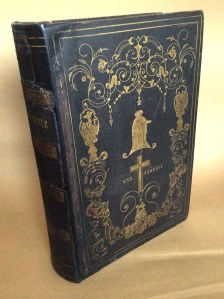
The Bible that belonged to Ann Farrell prior to her marriage was used to record the births, marriages, and deaths for the McKeon family in Stamford but no references to Ireland or to Patrick’s or Ann’s parents were mentioned inside it. Ann’s official death record from 1893 in Stamford, however, actually lists both of her parent’s names there: John Farrell and Mary Farrell, both born in Ireland. (iv) It’s unclear if Farrell was Ann’s mother’s maiden name or if her mother was simply recorded under her married name in that record.
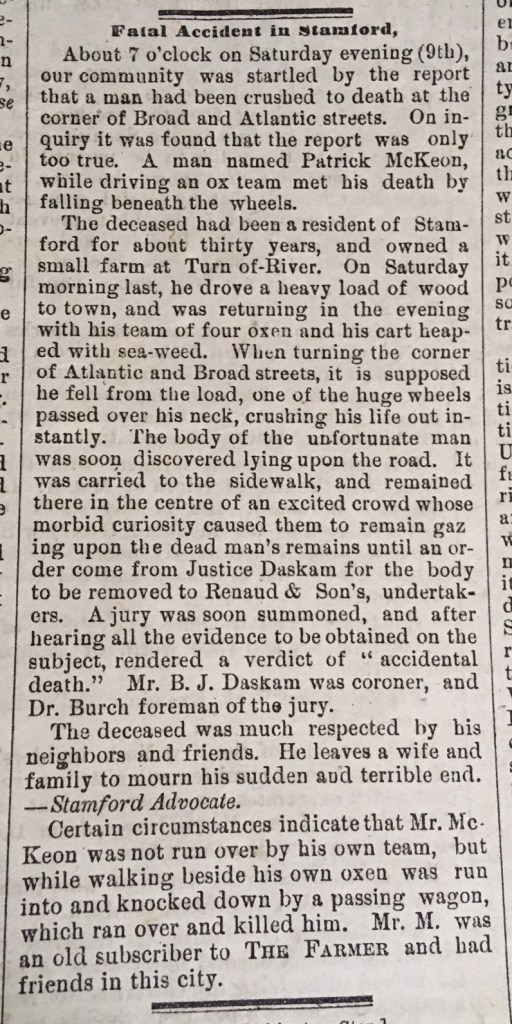
When Patrick McKeon died tragically at the relatively young age of fifty-four in 1871, he left behind a wife and seventeen-year-old son who would bear responsibility for the management of the farm. He was killed on the 9th of December having been struck and run over by a wagon that was trying to pass him as he made his way through an intersection in downtown Stamford. Patrick was walking alongside his own oxen-driven cart which had been loaded up with seaweed harvested from Stamford’s coast on Long Island Sound. The seaweed that he was returning home with would likely be used to help enrich the soil on his land in between the growing seasons. Though this shocking news was reported in a few local and state newspapers and despite the fact that a coroner’s inquest was held, no official record of either event has been located. A 1904 fire that destroyed Stamford’s Town Hall and many records housed there may be the reason for that.
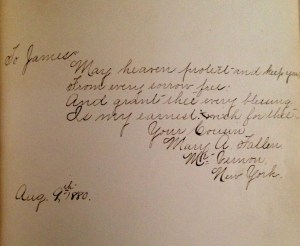
Some other important family clues were provided in the form of the sponsors at the baptisms of Patrick’s and Ann’s three children. There were three different women with the surname Donnelly who were sponsors at each of the McKeon children’s baptisms: Mary, Rose, and Anna. The quest to locate and identify any of these Donnelly women proved very difficult. A clue which helped to find one of the women was found in a circa 1870’s school autograph album belonging to Patrick’s and Ann’s youngest son, James. Some of the inscriptions found inside the album are undated and those appear to be the earliest. They were likely made by local North Stamford schoolmates of James as they often include the word “Riverturn” along with their signature. Apparently this was a variant place name also used to describe the area of Stamford where they resided. Other signatures are dated from around 1879/1880 and are signed by some people with out-of-state residences. One of these out-of-state entries turned out to be an instructor who was discovered by searching the federal census records from 1880. That instructor taught at a commercial business college in Manchester, NH and his signature and that of others from various places in the northeast indicate that James and these others were students who attended this college for some time up until around 1880. Most interesting of all the entries in the book, however, was a signed page from a previously unknown relative, a Mary A. Fallen of Mt. Vernon, NY dated August 9th, 1880. It is signed “your cousin”. Mount Vernon is a suburb of New York City, located in southern Westchester County where it borders the Bronx and is approximately twenty miles from Stamford.
This was an important clue to locate because not only did it open up an additional line of family research but it also helped solve another mystery about how one of the final land acquisitions during Patrick McKeon’s life possibly came about. There was a tract of land in Stamford that was sold to Patrick McKeon by William Falaan in January of 1870. Locating a William Falaan in Stamford had been unsuccessful but now it seemed that in finding the name of this cousin, Mary Fallen, it might mean that there was a family connection involved with the land sale. A search of the U.S. Census records for Mt. Vernon from 1880 resulted in locating a Mary Fallen, age 15, living with parents William and Mary Fallen, who were both born in Ireland. Young Mary’s two older brothers are also on that record. Mary’s birth location lists New York, but her brothers have Connecticut listed for theirs. The family was in Mt. Vernon as early as 1870 where they are also recorded on the U.S. Census record that year but possibly were there as early as 1865 based on Mary’s New York birth location listed on those two census records. The sale of the land to Patrick may likely have been due to the family’s move from Stamford to Mt. Vernon being of a permanent nature.
As it turns out, the mother of cousin Mary Fallen from Mt. Vernon was Mary Donnelly Fallon; a fact revealed in an obituary for one of “cousin” Mary’s older Fallon brothers, Edward. (v) The spelling of the family surname eventually had been standardized over time to ‘Fallon’, with an ‘o’. Also, quite remarkably, noted in Edward Fallon’s obituary was the fact that he was born in Stamford! Mary Donnelly Fallon was, no doubt, one of the three Donnelly female baptism sponsors who was being searched for. Mary was named as the female sponsor on the baptism record of John Joseph McKeon, my father’s grandfather, who was born in 1854 in Stamford. When the revelation was made that Donnelly was Mrs. William Fallon’s maiden name, and not McKeon or Farrell, the thought occurred that the three Donnelly females were possibly all single women at the time that the baptisms of Patrick and Ann’s children took place and that they were siblings. Then, ostensibly, these Donnelly sisters might be nieces or first cousins to either Patrick or Ann, presumably daughters from the marriage of a McKeon female or a Farrell female to a Donnelly male. That would mean that young Mary Fallon might actually be a first cousin once removed or perhaps a second cousin to James McKeon. But aside from the actual relationship, which side of the family were they from?
DNA testing helps unlock the mystery
Back in 2011, I had decided to take the Ancestry DNA test in the hope that it would assist in expanding my genealogy research. Some months after that, my first cousin, Rose took the test along with her mother, my paternal aunt, and I was given access to their match results. Sometime after the Ancestry DNA test results came in, I then decided to take a y-DNA test because exploring my direct paternal line was such an important component of my family research. That proved to be somewhat confounding because when the y-DNA results came back it didn’t result in a single McKeon surname match among my list of matches. I learned then that somewhere back in time for our McKeon lineage there was likely what genetic genealogists refer to as an NPE which refers to a non-paternal event or more appropriately a misattributed parentage in one’s lineage. It basically describes a disconnect in the link between the Y-chromosome and a surname for a male line. So at some point, our male ancestors may have carried a different surname (such as Murphy or Kelly) but picked up the McKeon surname at a later time for reasons that may include adoption or fostering, infidelity, an illegitimate birth where the child takes on the maternal surname, a family name change, etc., etc.
The most numerous surname matches to appear among my y-DNA matches is the O’Gara surname, including a few O’Hara surnames. It is said that both the O’Gara and O’Hara surnames are closely related historically and are of the same more distant paternal lineage originating in Connaught, in the west of Ireland, around one thousand years ago. Next were some McAlister surname matches. The McAlister matches all appear to reside in the U.S. and most of these, I’ve come to understand, are known descendants of two brothers (presumed relationship) who settled in New England in the early 18th century after emigrating from Ireland. The families of these brothers have been documented and there are published family histories in the U.S. that have identified Ulster as the region in Ireland where their McAlisters originally came from. The O’Gara and O’Hara surname matches are more widely spread out geographically than the McAlisters, residing in Ireland, the U.K., Australia and the United States. They include some members of Clan O’Gara in Ireland but they don’t seem to have a more specific common connection, save for a few who are related to each other. One of these O’Gara yDNA matches also happens to match me distantly on the autosomal DNA or family finder test on FTDNA. His sister is the head of Clan O’Gara in Ireland, who also matches me. Their most recent O’Gara family roots are from Boyle, Co. Roscommon but their known more distant O’Gara roots are not terribly far away from there, near an area close to Lough Gara in Co. Sligo.
Because the known common lineage for the McAlister matches is from a much more recent genealogical time frame and they don’t show up alongside any other McAlister matches in Ireland or elsewhere, I have regarded these less numerous but similarly related surname matches as more of an outlier than the O’Gara and O’Hara matches. That reasoning could certainly change if any additional future DNA revelations emphasize that connection to be something more significant. Though the y-DNA match results were intriguing and may hint toward our deeper paternal origins, it was apparent that this might not be the particular tool, at this point in time, to help in providing substantial clues in narrowing down our more recent McKeon ancestral origins to a more specific geographical area in Ireland. So the plan, then, was to focus on the autosomal DNA match results. Besides my own DNA test, I was given access to my paternal aunt’s DNA test as well as my first cousin’s. Now it was time for a waiting game.
Back in 2012 while performing searches on Ancestry for those Fallon family members from Mt. Vernon, a family tree showed up in the results. The tree belonged to a direct descendant of William and Mary (Donnelly) Fallon but when contacted the woman who created the tree stated that she didn’t know much about her distant family history. In 2016 this same individual also took the Ancestry DNA test and showed up as a distant cousin match to my paternal aunt. Now there was confirmed evidence of a blood relationship but at the distant cousin level, there wasn’t much to glean from the match other than what little was already known. A year later in 2017, another direct Fallon/Donnelly descendant showed up among matches for me at the predicted 4th cousin level, and then another, also at the 4th cousin level.
The next new development that Ancestry-DNA provided turned out to be a game-changer. A tool was added providing new analysis that gives the ability to view DNA matches that are shared in common with you and another of your matches. (vi) Those shared matches might have family trees that reveal certain identifying clues that could be particularly helpful in finding a connection to an otherwise unknown relationship. So if, for instance, you noticed that a significant match of yours had a surname that exists in both their family tree and your own, then you could look at the trees of the shared matches between both of you to see if there is a similar connection that they share to that surname as well. That connection could be a common family location, a common pattern of first names, or any other important identifying factor or clue. Then after examining these family trees, or in many cases building them out further yourself, (often trees found online for your DNA matches aren’t very well developed), you might find some hints that lead you to discover an actual relationship. Family researchers refer to the practice of building another match’s family tree as the “quick and dirty method” because the main purpose is to try to quickly discover if clues about a relationship to a match can be easily made rather than taking valuable time to verify each and every detail in the tree building process which may or may not result in finding the actual connection.
Well, after this new development appeared at Ancestry DNA, suddenly it seemed that all the stars had aligned! Margaret*, a predicted 3rd cousin match to my paternal aunt showed up in 2018 and is a direct descendant of none other than John McKeon and Ellen Maher of Stamford. Margaret would actually be a third cousin, once removed to my aunt if the theory about John McKeon and Patrick McKeon being brothers was correct. So, the predicted cousin level here appeared to be spot-on for the theory. This same match was also a shared match at the predicted fourth cousin level with me, two of my McKeon first cousins who later tested and also with one of the Fallon/Donnelly descendants of Mt. Vernon. That immediately suggested that the Donnelly family connection looked to be from our McKeon side and not from the Farrell side as there is no known Farrell connection with the McKeon/Maher line. Next, appeared even more matches who were also direct descendants of John McKeon and Ellen Maher who began to show up at the predicted fourth cousin match level for my aunt, me and my cousins (plus a few at a more distant cousin level).
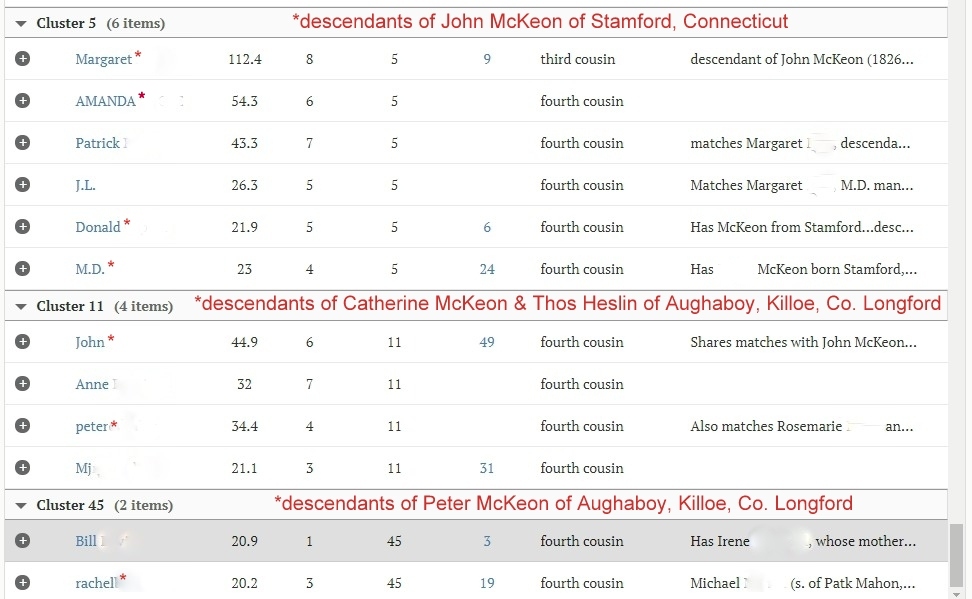
Looking one by one into the shared matches existing between the two lines of the Stamford McKeon descendants and also the Fallon/Donnelly descendants, something else very interesting was revealed. Some of the shared matches that are not in any way known to be associated with either of the Stamford McKeon families or the Fallon/Donnelly families also had McKeon lineages with ties to a rather specific location in Ireland. One of these testers, John*, was actually kind enough to give me access to view his list of matches. He had a public family tree that identified his 2nd great grandparents as Thomas Heslin and Catherine McKeon who married in 1840 in Killoe parish in County Longford, Ireland and lived in the townland of Aghaboy (sometimes spelled Aughaboy) in Co. Longford. A second cousin of that tester, Peter*, also showed up as a predicted 4th cousin match and he is also descended from the same Heslin/McKeon ancestors from Aghaboy. Still another shared match, Rachel*, is a 4th cousin match whose ancestor, Peter McKeon (who married Mary Dooris in Killoe in 1858), was also from Aghaboy. Another 4th cousin shared match for John* and my test (at just one mark off the predicted 4th cousin threshold) was “Francis”, whose Thomas McKeon lived in Ballincurry, a townland just to the west of Aghaboy, and also part of Killoe parish. Francis doesn’t show up in my aunt’s matches but he also shows up as a distant cousin to a McKeon second cousin of ours who was born in Stamford. Rachel* and “Francis” are not part of the direct Thomas Heslin/Catherine McKeon line, but their Peter McKeon and Thomas McKeon ancestors may have been brothers or first cousins to Catherine McKeon Heslin based on the match predictions. Ballincurry and Aghaboy are, still to this day, rural townlands comprised of small farms. A townland, by definition, is the smallest geographical division of land in Ireland.
Discovering what’s referred to as ICW or an In Common With connectedness for these shared DNA matches along with a known place of origin in Ireland for some meant that it was time to focus in on some record sources. Knowing that there are only a few remnants of Irish censuses from the 19th century that survive to this day, I quickly thought to do a search online of Griffith’s Valuation a.k.a. the Primary Valuation of Ireland. This was a property tax survey that was conducted in the mid-19th century throughout all of Ireland and published between 1847 and 1864. Since this lists both the owners and leaseholders of all property in the country by townland (so it also includes tenant farmers) it is regarded as a type of census substitute for the period around the time that my McKeon ancestor left Ireland.
The other important census substitute from around this same time is the Tithes Applotment Books. This record is from slightly earlier, 1823-1837 and was used to record the amount calculated that all land occupiers, Catholics included, were required to pay in tithes to the local Church of Ireland, the protestant state-established church.
The downside for these census substitutes is that in being property records, they only record owners and holders of land at the time, not all inhabitants. They are extremely useful, nonetheless. The tithes record from 1833 lists among the several occupiers in Aughaboy a Thomas Heslan, a John McKeon and a James Donnelly (as co-partner of a James Campbell). The 1854 Griffith’s Valuation published record for Aghaboy, some twenty years later, lists among the occupants presumably the same Thomas Heslin & John McKeon found in the Tithes Books and now a Christopher Donnelly (perhaps a son or brother of the previously mentioned James). So in addition to the already known Heslin/McKeon ancestors for our shared DNA matches living in Aghaboy, we learn of a McKeon male and a Donnelly male who were also holding land and living and farming in this very same location.
Per Griffith’s Valuation, the total acreage in the townland of Aghaboy is four hundred and forty-two acres, of which sixty-one were bogland. There are approximately forty-five individuals listed in the record as holders of land here, the largest holder among them with only thirty acres, but many with holdings in only the single digits. To help understand the overall size of this townland, it amounts to roughly half the size of New York City’s Central Park.
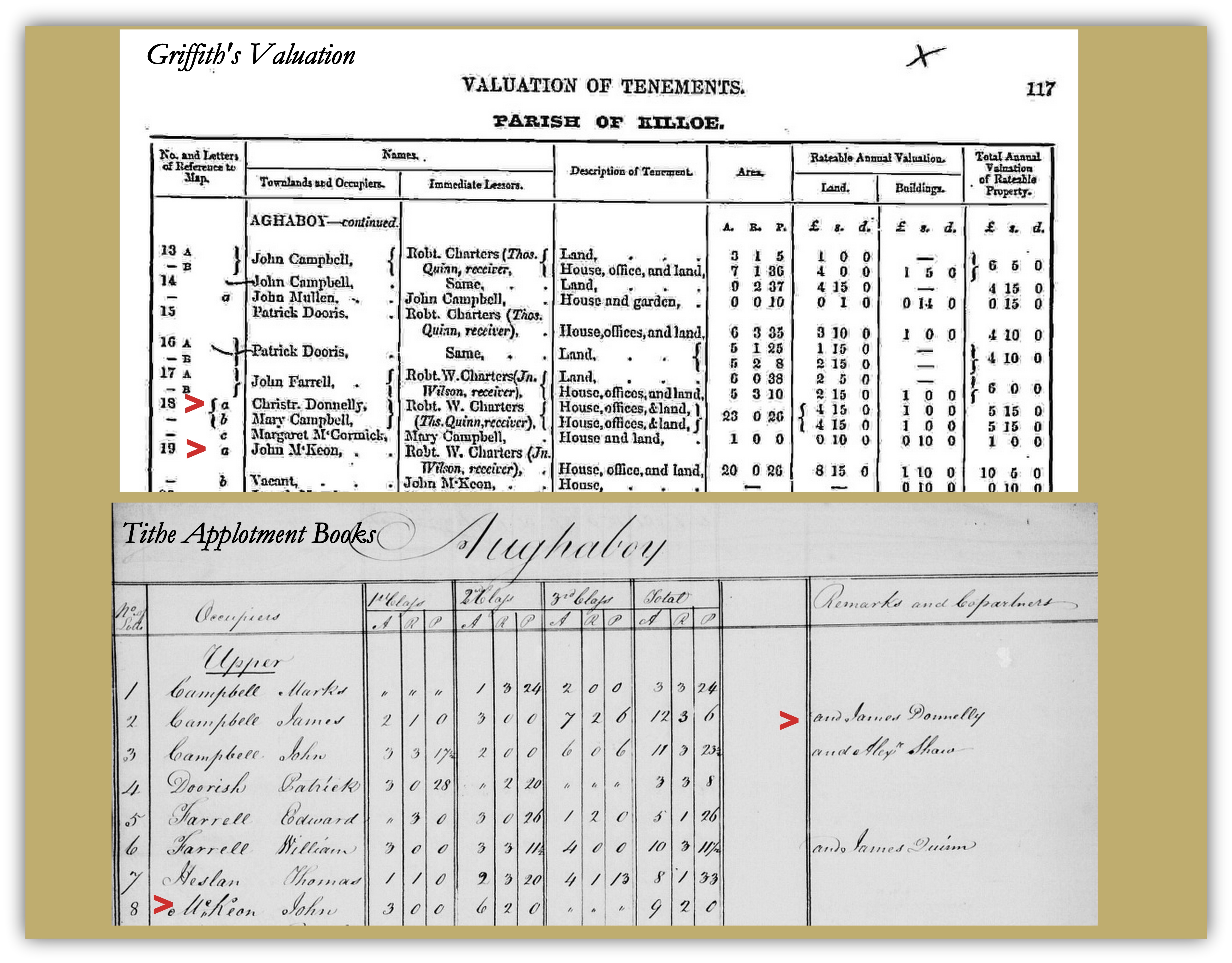
In doing family research over the last several years I had joined a number of genealogy groups on Facebook which have been great resources to learn about the histories of the particular localities that they represent, especially from folks who have direct ties to those locations. One of these groups that I came to join was the County Longford Genealogy Group. I was waiting to get a bit more information about these DNA matches of ours and our connections to County Longford before posting my information there when back in July of last year someone else had posted on the group’s page about their husband’s connection to Aghaboy. I decided to comment on the post to see if that person’s husband had his DNA tested and mentioned some of what I had found in my research. In response to my comment, another member of that group named Will Hongach replied and told me that he had Aghaboy ties through a McKeon 3rd gr grandmother. He then informed me that the ancestor was Catherine McKeon, (wife of Thomas Heslin) who he was descended from. Will told me that he also tested his DNA on Ancestry, as did his mother. I had a look on Ancestry and found Will and his mother listed as distant cousin matches for me and my aunt. Only one shared match popped up for them and us and it was the previously mentioned match, John*, who also shared the Heslin/McKeon direct ancestors with Will and his mother. John matched them both as a predicted 4th cousin. Will’s maternal grandfather was born and raised in Aghaboy and Will had much to share with me about his family lineage and the history and records available from the area.
By now, I was becoming fairly well satisfied that Killoe parish in County Longford was where my McKeon family must have come from before arriving in the U.S. Whether or not the John McKeon listed in Aghaboy in the Griffith’s Valuation and Tithes records was the actual father of our Patrick McKeon, it was certainly a strong possibility that he could be. Irish naming patterns suggest that the first son born is named after his paternal grandfather. While that’s not always the case, and in some families the first son doesn’t even live long enough to make it into certain records, in this particular one it fits the bill as my McKeon gr grandfather was the first son of Patrick and he was indeed named John.
I theorized with Will that my Patrick and his Catherine McKeon might have been siblings based on the strong connection that he, his fourth cousin and me and my relatives have via the DNA but also based on the estimated birth years for Patrick and Catherine being in line with a sibling relationship. The shared connections between the other descendants of the McKeons from Aghaboy and Ballincurry, both of the two Stamford McKeon lines and the Fallon/Donnelly family was just simply beyond compelling for it to be otherwise for me.
Will informed me that church records for Killoe parish begin in the year 1826. That’s not bad for many Irish Catholic parishes but would be too late for finding a baptism record for Patrick McKeon or even John McKeon, but perhaps other records of interest might be found there. The Christopher Donnelly living in Aghaboy per Griffith’s seemed to show up in a number of the 19th century Killoe church records as a witness or sponsor for weddings and baptisms of McKeons of Aghaboy and Ballincurry that I had looked up. I wondered would I be able to tie this Christopher Donnelly with any of the known connections from America?
There was quite a stroke of luck in coming upon a website that had a very handy index of all the births, marriages, and deaths listed in Killoe parish which had been neatly alphabetized. (vii) In scanning the baptism records there I came across a number of them that begin in the year 1829 for the children of a Christopher Donnelly and quite amazingly, his named wife, Mary McKeon! And with no other Christopher Donnelly listed with children baptized from this time frame for Killoe, I figured that I might be onto something to help provide more substance than just the DNA shared match connections. Beginning in 1829, the list of Donnelly/McKeon children’s baptisms was a Bridget, Margaret, Ann, Elizabeth, Rose, and a son, Christopher Donnelly. Now here we can see two females with names that match the baptism sponsors for two of Patrick and Ann McKeon’s children; Ann or Anna Donnelly, and Rose Donnelly. And they are indeed daughters of a Donnelly father and a McKeon mother, as suspected might be one alternative. But we don’t see a Mary listed among the children, so what of Mary Donnelly Fallon of Mount Vernon then?
Knowing that I had already reasonably surmised that Mary Donnelly Fallon was related to my Patrick McKeon as either a niece or first cousin, I decided to see if I could obtain her death record. I had the date of death from her newspaper obituary and wrote to the City of Mt. Vernon, NY for the record. My fear was that I would have one more disappointing experience with yet another record missing key details. From the record received, Mary Fallon, it stated, was born in Ireland, but the nice surprise was that it actually listed the name of at least one parent. Not her mother, but her father. There in black and white was the name, Christopher Donnelly.
Now, the only problem is that there is no Mary listed among the baptisms for Christopher and Mary McKeon Donnelly from Killoe. It is possible that the baptism for Mary is missing or wasn’t recorded at the church for any number of reasons, or Mary is actually ‘Margaret’ who was baptized in February of 1832 and she went instead by the name Mary. It is not unheard of in Irish families that some children go by a middle name or a variation of their actual name, sometimes to avoid confusion with someone else in the family with the same name. Repetition of first names among the Irish is rampant. In any case, on the death record for Mary Donnelly Fallon from 1910, her age at death is listed as 78, which would indicate a birth year of 1832. Similarly, on the 1900 U.S. Census, Mary Donnelly Fallon lists the month and year of birth on that record as March 1832. It’s remarkably close to the February 1832 baptism date that we find listed for Margaret Donnelly.
One of the other interesting discoveries made after finding all these shared McKeon DNA matches were some threads found in old message boards on Ancestry about the family of Thomas Heslin and Catherine McKeon. These seem to start around 1999 and last for a few years. Some of these are answered by a ‘Kate H’, later discovered to be the sister of Peter*, our DNA match. Another is Nancy Coogan, who was in touch with Kate there and has created a family tree going back a generation further beyond that of Catherine McKeon Heslin of Aghaboy and with whom I’ve been in touch. While our McKeon family lineage isn’t yet included in Coogan’s tree, we are working toward fitting it in somehow, based on the DNA shared matches and other supporting records.
Included in Nancy’s online tree is General Seán MacEoin who was born John Joseph McKeon (1893-1973) in Longford and who fought in Ireland’s War of Independence and later became an Irish politician and statesman. Will Hongach had explained to me that his relatives in Aghaboy knew for a long time prior to the start of his own family research that they were related to Seán MacEoin.
In September of 2018, I was scheduled to be in Ireland with my sister, brother-in-law and one of my nieces, along with our older sister to visit with our maternal aunt in County Mayo. In finding this recent information about our McKeon connections to Co. Longford I informed a good yDNA match of mine named John Cummings about the news. I’ve been in contact with John for a number of years now, each of us assisting the other in trying to identify connections with our deep common paternal lineage and hoping to break through our individual genealogical brick walls. John has been very generous over the years sharing information and keeping in contact with other matches. He reminded me that one of our matches lived in Co. Longford and that I should reach out to him if I planned on making a visit, perhaps gaining some local insight before my trip. His name is Aidan O’Hara and he lives just on the outskirts of Longford town.
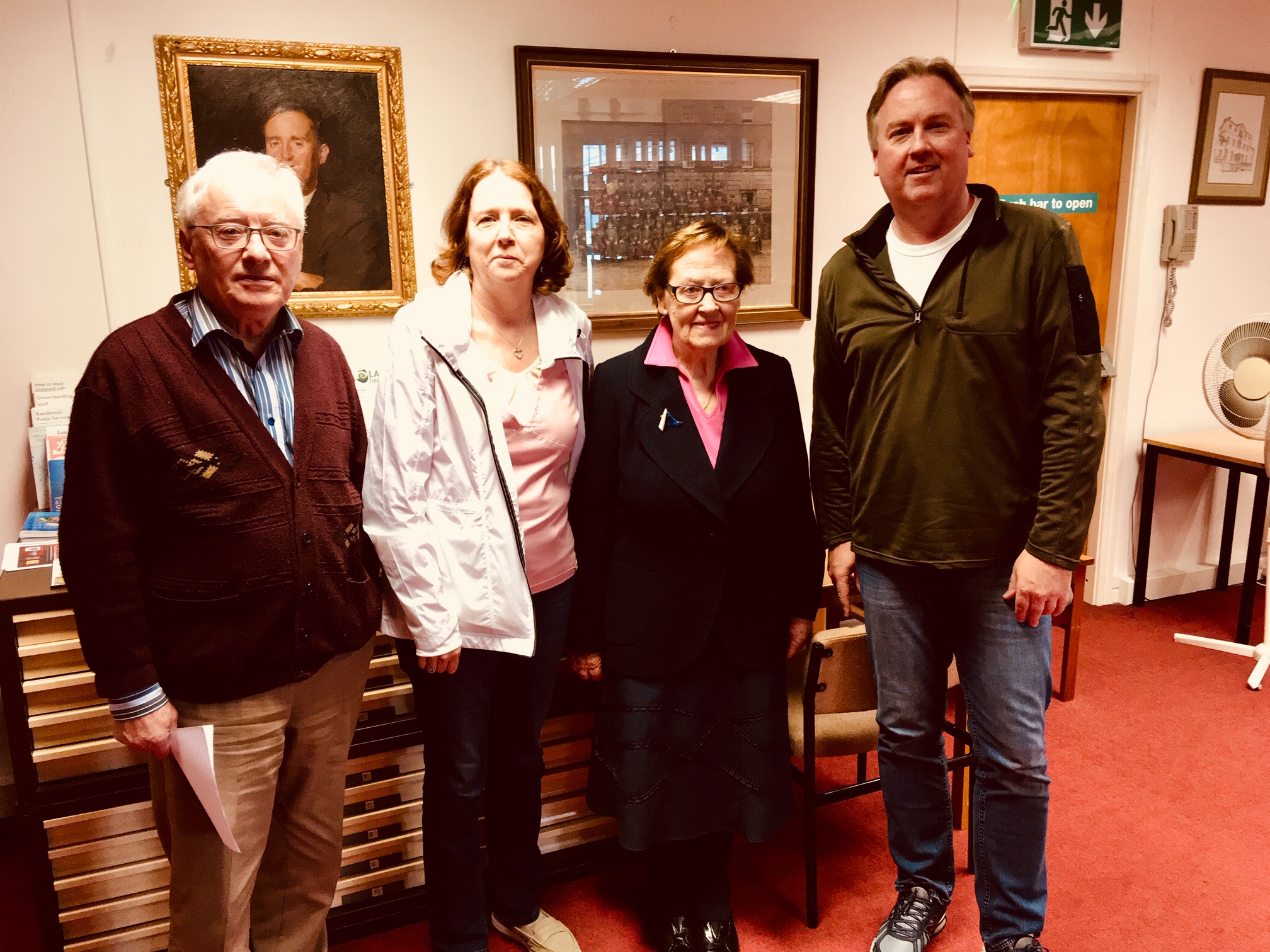
When I contacted Aidan, I gave a good bit of detail about the DNA information that I had found and also included Nancy Coogan’s family tree. He immediately replied back and kindly invited me to meet up with him when I was going to be in Longford. Aidan’s O’Haras were from Drumlish, Co. Longford, only a few scant miles from Aghaboy. One day in the middle of our trip my sister Maureen accompanied me for the ride from County Mayo to Longford and our day began with some tea with Aidan and his lovely wife, Joyce, at their home, followed up with a visit to the County Library in Longford town where Aidan had arranged to meet with the archivist there, Martin Morris, and Aidan’s friend, Catherine Donohoe, a niece of General Seán MacEoin. We had a nice discussion of some of the history of our family’s and the records there and how we might all be connected. Catherine had brought along a partial family tree that she had received from a McKeon cousin that was similar in part to the one produced by Nancy Coogan.
We then went back to the O’Hara’s for a nice lunch prepared by Joyce and had a wonderful discussion of all kinds of history and family…so many topics, and then finally Aidan kindly guided us off toward Aghaboy and Enybegs where the local parish church is to be found. We spent about an hour and a half visiting the church, the newer local cemetery, Begley’s Bar and shop and drove past the fields of Aghaboy. The day flew by so quickly that it was decided there will have to be a return visit to really soak up more of the flavor of this part of Ireland where we have discovered family roots, to properly thank Aidan and his wife for their hospitality and to hopefully find more discoveries!
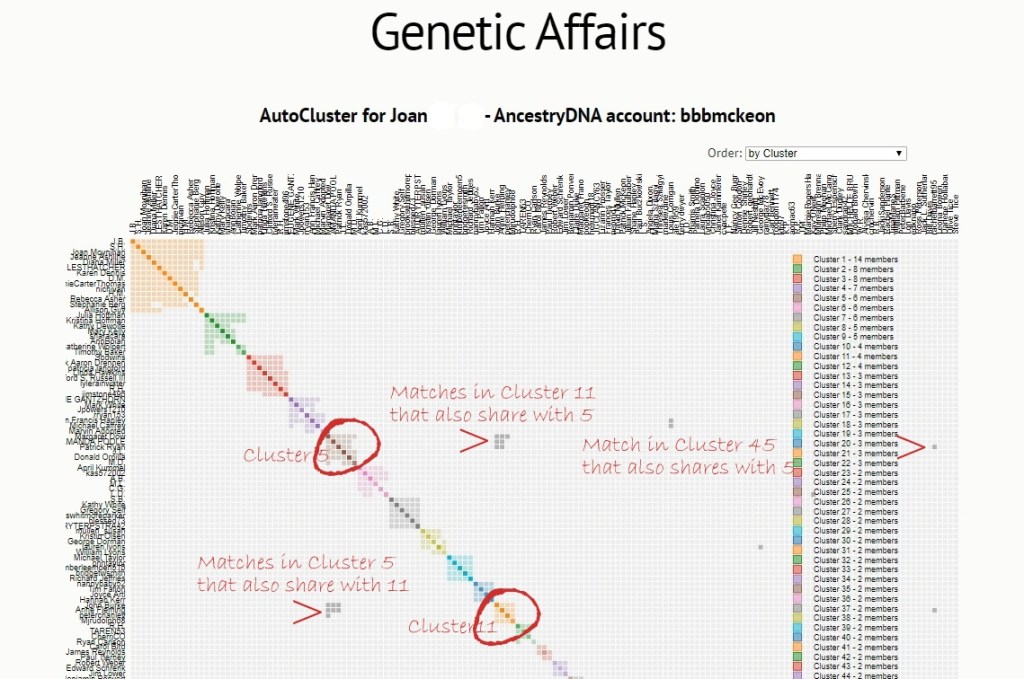
The final image below is from a wonderful website and tool called Genetic Affairs. Using your DNA matches on Ancestry or via the other two major DNA testing sites, it arranges your DNA shared matches into color-coded sets of clusters that are each likely from a same ancestral line and who possibly share the same most recent common ancestor(s), say a pair of gr grandparents, for instance. I added this image of my paternal aunt’s DNA match clusters along with its corresponding chart of the named matches (*without any identifying surnames) for each of her clusters of matches for descendants of the family of John McKeon & Ellen Maher of Stamford and the Aghaboy McKeon families which helps to illustrate how they may relate to one another. The Fallon/Donnelly matches that are at the 4th cousin match level for me are at the distant match level for my aunt and so do not appear here since Ancestry only compares shared matches from the 4th cousin level and better (as is also the case for the other McKeon descendants who have predicted levels below 4th cousin for my aunt). My aunt’s close family matches (me, her daughter, nieces, and nephews, etc.) have been left out of the example in order to concentrate the visual on her link to these other McKeon descendants exclusively. In the AutoCluster chart image, you can see some gray cells that appear outside of the angled line of clusters that runs from top left to bottom right. These outer gray cells represent the DNA matches that are connected via two clusters indicating their close relationships to each. The chart very nicely presents a good visual of how these descendants might all connect as described above but are most definitely all somehow closely related.
Close
DNA matches for our family with other matches that also have Farrell surname lineages show some strong links close to the Lanesborough, County Longford area. That will be another area to research in the near future. It’s completely reasonable now to assume that our McKeon and Farrell ancestor’s union was likely made possible, as it was for so many other early immigrant couples, through others close to them. Relationships were generally established through friends and/or relatives or people who knew other people. Immigrants often settled in clusters living among relatives and friends from the same county and that is where most men and women often were introduced before forging a relationship. Those kinds of assumptions about how relationships developed for our early immigrant ancestors should be remembered and reinforced when conducting our research.
Another thing to keep in mind are the more modern aspects of genealogy. There’s a saying these days that DNA doesn’t lie. That’s very true, but it’s equally true that DNA evidence alone can’t prove a genealogical connection. It must be accompanied by other evidence in order to firm up what might generally be just simple speculation.
What has been outlined above began with indirect evidence of a suspected sibling relationship for my McKeon ancestor in Stamford. That theory was later given more weight via DNA matches with descendants of our two suspected McKeon siblings. A link was then made to shared DNA matches with known connections to the McKeon surname (the common factor for all) and then a common location of origin in Ireland for the McKeon descendants identified via the shared DNA matches. Closing the circle was the Donnelly cousin relation’s descendants that tied to everyone with the McKeon connections through both DNA and then family baptism records discovered for them from the same location in Ireland identified by the shared matches.
Whether the John McKeon identified in Griffith’s Valuation or the Tithe Applotment records is the father of my Patrick McKeon or another individual is, through the DNA connection and cousin’s records discovered we’re unquestionably linked to Killoe parish and specifically, Aughaboy, County Longford via a shared McKeon lineage.
To be continued…

 McKeon Family History